

Oilheat Facts
Replacing an old inefficient system with a modern Oilheat system can reduce heating bills by approximately 40%.
Search Our Site
Oilheat Facts
Replacing an old inefficient system with a modern Oilheat system can reduce heating bills by approximately 40%.
Oilheat Facts
Oilheat Facts
Replacing an old inefficient system with a modern Oilheat system can reduce heating bills by approximately 40%.
Replacing an old inefficient system with a modern Oilheat system can reduce heating bills by approximately 40%.
Replacing an old inefficient system with a modern Oilheat system can reduce heating bills by approximately 40%.
 Home Knowledge Base Equipment How It Works
How It Works
Ever wonder how your heating system works?
For an Oil Furnace System:
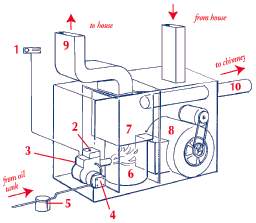 The thermostat (1) sends a signal to the controls (2) on the burner (3). The fuel pump (4) draws oil through a filter (5) to the burner. The burner turns the oil into a fine spray, mixes it with air and ignites it in the combustion chamber (6), causing the chamber to become very hot. Air absorbs heat in the heat exchanger (7). A blower (8) sends this air through ducts (9) to heat the home. The air eventually circulates back to the heat exchanger and the cycle continues. Combustion emissions are vented out the flue (10).
For a Hydronic Boiler System:
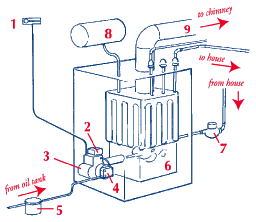 The thermostat (1) sends a signal to the controls (2) on the burner (3). The fuel pump (4) draws oil through a filter (5) to the burner. The burner turns the oil into a fine spray, mixes it with air and ignites it in the combustion chamber (6), causing the chamber to get very hot. Water circulates around the combustion chamber. A circulator (7) pumps the heated water through radiators or baseboards to heat the home. An expansion tank (8) adjusts to varying pressures. Eventually, the water returns to the heating unit to begin the cycle again. Combustion emissions are vented out the flue (9).
How It Works
Ever wonder how your heating system works?
For an Oil Furnace System:
The thermostat (1) sends a signal to the controls (2) on the burner (3). The fuel pump (4) draws oil through a filter (5) to the burner. The burner turns the oil into a fine spray, mixes it with air and ignites it in the combustion chamber (6), causing the chamber to become very hot. Air absorbs heat in the heat exchanger (7). A blower (8) sends this air through ducts (9) to heat the home. The air eventually circulates back to the heat exchanger and the cycle continues. Combustion emissions are vented out the flue (10).
For a Hydronic Boiler System:
The thermostat (1) sends a signal to the controls (2) on the burner (3). The fuel pump (4) draws oil through a filter (5) to the burner. The burner turns the oil into a fine spray, mixes it with air and ignites it in the combustion chamber (6), causing the chamber to get very hot. Water circulates around the combustion chamber. A circulator (7) pumps the heated water through radiators or baseboards to heat the home. An expansion tank (8) adjusts to varying pressures. Eventually, the water returns to the heating unit to begin the cycle again. Combustion emissions are vented out the flue (9).